
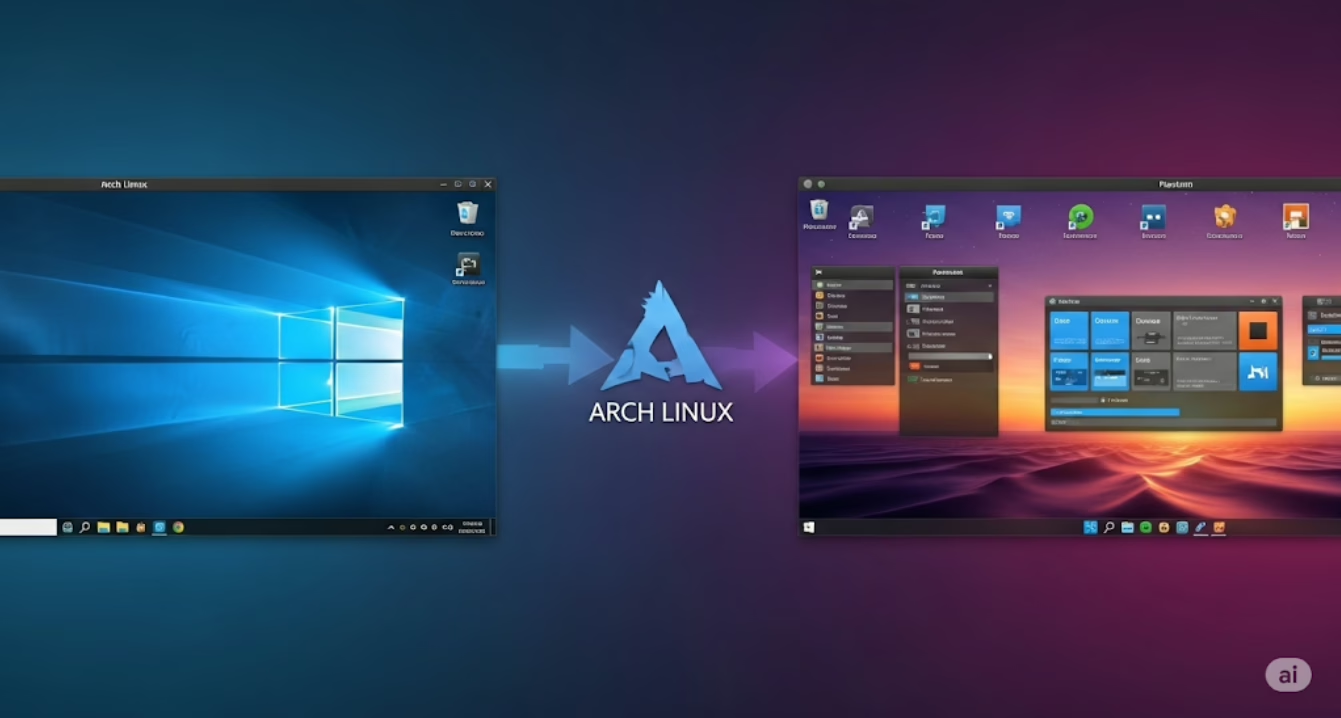
My background in the IT industry has always fuelled a deep interest in open source systems. Despite this, migrating my personal PC from Windows to Linux was a decision I had kept putting off. I ran tests and lab work on external Linux servers — online VMs or home Raspberry Pis. The reasons for not migrating were practical: concerns about hardware driver compatibility and uncertainty about whether I could still run my video games. Titles like Diablo, Path of Exile, Frostpunk and X-Com are an integral part of my free time — the prospect of losing access to them was a significant deterrent. Ultimately, however, the desire to operate on a completely open and customisable system won out.
First approach: Ubuntu and troubleshooting
I began the migration with Ubuntu, considering it the most accessible distribution: Valve itself uses it as the preferred distribution for Steam, so it seemed the path of least resistance for gaming. The approach proved effective. I gradually resolved all hardware-related issues, identifying the necessary drivers or alternative solutions.
Game compatibility was a positive surprise. Thanks to Steam Proton, most of the titles I used on Windows turned out to be fully functional on Linux directly from the Steam client. The real breakthrough was realising that Steam’s Proton implementation could, on its own, solve 90% of compatibility issues. The best approach was running clients from other gaming portals (Epic, EA…) as external applications launched through Steam: yes, you have to open two clients instead of one, but things just work. Perfect? No, there’s room for improvement — but the result was more than satisfactory.
Switching to Arch Linux: the search for full control
As my familiarity with Linux grew, the need for more granular control over the system emerged. Ubuntu’s approach, useful for getting started, had become limiting for my advanced customisation needs. There is no point in choosing a self-managed distribution like Ubuntu only to spend your time dismantling it. I opted for Arch Linux, whose nature requires manual configuration of every component — exactly the full control I was looking for. One thing to consider: the rolling release update methodology. But it was worth trying.
Arch Linux: stability and operational flexibility
Contrary to potential concerns, Arch’s rolling release approach, managed with appropriate practices (systematic backups and monitoring of system announcements), proved stable and highly flexible. The Arch-based system with a Plasma desktop environment fully meets my expectations. The combination of lightness and extensive customisation capabilities allows the environment to be optimised for specific needs.
To maximise gaming performance, I integrated the Zen Kernel: a kernel optimised for responsiveness that makes the most of available hardware. The result is a further improved gaming experience. Using a dual kernel requires some extra configuration at the GRUB and Nvidia driver level — but once the main issues were resolved, everything started working properly.
A tailored system, in continuous evolution
Today I have a system completely configured to my specific needs. No more restrictions imposed by closed systems: an operating environment I can freely shape and adapt. The migration was a great experience, though I do not consider it a destination: it is a process of continuous improvement and tuning, and it’s good that it works that way.
Does it require study? Yes. Could there be complications? Of course. Do I recommend it? Absolutely yes.