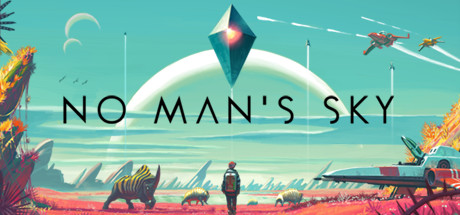
There was something special about the summer of 2016, when No Man’s Sky launched amid enormous expectations and equally enormous controversy. This post isn’t a review — it’s the account of an experience, much like the galaxy it describes: personal, unique, unrepeatable.
What Is No Man’s Sky?
It’s a space exploration game in which you play an adventurer, waking up after an accident and completely lost on one of the many planets of a vast galaxy. At your disposal: only your spaceship in need of repair, your survival suit with its backpack, and a singular object called the multitool. The latter is useful both for defending yourself and for extracting minerals from the rocks and vegetation you’ll encounter.
Minerals are the key to crafting anything: their combinations allow you to create more complex elements and even objects. A bit like Minecraft.
Only once the spaceship is back in working order — an activity that obviously functions as a mere tutorial — can you begin your journey. The destination is the very centre of the galaxy. Why you’re headed there is not revealed to you, but in the end it’s not really that important. The true purpose of the game, from the very beginning, seems to be the journey itself.
An Infinite Galaxy. Or Nearly So.
For the uninitiated, the original idea behind NMS was to create a universe of planets entirely through a procedural algorithm. The developers combined a series of mathematical algorithms and physical rules to automatically generate an entire universe of stars, planets and asteroids. The numbers say: over 18 trillion planets. On each planet you can find oceans and continents with vegetation and animals, also created on the basis of automatic procedural and pseudo-random algorithms.
Why? To create a truly boundless and unexplored universe where every location you discover is genuinely something no man has ever seen before… not even the developers themselves.
Are there limits to all this? Certainly yes, and after a while you’ll start to notice some repetition. But it doesn’t matter. What matters is that your first hour in NMS is fantastic. I felt like a kid stepping into an episode of Star Trek, wondering: what’s on that planet? Will the air be breathable? Glaciers or scorching heat? Will there be animals?
Where Am I Now?
I’m now beyond my thirtieth hyperdrive jump and the feeling is still there. I could tell you about that planet with its singular rocky formations that looked like enormous roots, or that small forested moon orbiting next to that giant red planet… this game is made of exactly this: the pleasure of exploration.
Is it perfect? Absolutely not. The limitations of the algorithms become apparent after a while. But it doesn’t matter, because I’m still not tired of it and every time I think I’ve seen every possible variation I find something new and unexpected. I’ve read several articles about the limitations of this title compared to what was initially promised, but the idea at its core remains unique and deserves a chance.
Some games are built by teams of writers, graphics teams, dozens of programmers and armies of beta testers. NMS is not one of those. And yet, with all the limitations of an indie title on a restricted budget, this game gave me a feeling that very few others had managed to give me before: the thrill of being “where no man has ever gone before”.
For the rest, I’ll update you later. Right now I need to find a way to get more Antimatter: I have an appointment with the Atlas in the next star system. Let’s not keep it waiting…