
How I developed a complete classic arcade game in less than a working day
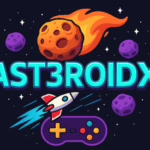
After the experiment with BOMBRIS, I wanted to test Claude Sonnet 4.5 on a more complex project: a real space shooter with realistic physics, unlockable achievements, and an advanced particle system. The result is AST3ROIDX — a tribute to Atari’s classic Asteroids (1979), developed in less than 8 hours using Claude Sonnet 4.5 and Claude Code.
Claude Sonnet 4.5: Concrete Improvements
Sonnet 4.5 is the latest iteration of Anthropic’s AI, with significant improvements over version 4.0 used for BOMBRIS:
- Improved mathematical reasoning for physics and vector calculations
- More effective handling of complex code and multi-layer architectures
- Ability to generate more sophisticated procedural algorithms
- More precise assisted debugging
AST3ROIDX required specific expertise in collision physics, performance optimisation, and managing interacting systems — all areas where Sonnet 4.5 proved particularly capable.
The Project: From Classic Arcade to Modern Version
The original Asteroids was a 1979 vector game with white line graphics on a black background. The idea was to keep the classic gameplay but completely update the presentation: modern graphics, achievement system, realistic physics, particle effects, procedural audio, and mobile support.
The Process: A Conversation, Not Structured Phases
Contrary to what you might expect, I did not follow a structured development plan. The process was completely conversational and iterative.
I started by simply describing to Claude what I wanted: an Asteroids clone with modern graphics. I specified some basic technologies — HTML5 Canvas, JavaScript ES6 — while other technical choices were proposed autonomously by Claude, such as using the Web Audio API to generate sounds procedurally instead of pre-recorded audio files. Then I started adding features progressively.
“I want the ship to have realistic inertia.” Claude implemented the physics.
“Add a shield system with limited charges.” Done.
“Asteroids should fragment into smaller pieces when hit.” Implemented with elastic collision physics.
“I’d like an achievement system that tracks various objectives.” Claude created 17 different achievements with real-time tracking.
Each request was elaborated, implemented, and then tested. When something didn’t work as I imagined, I just described it conversationally: “The ship explosion looks too simple, I want something more spectacular with multiple waves of particles.” And Claude would iterate on the solution.
Conversational vs. Traditional Development
What makes this approach different is not just the speed, but the way of working. I didn’t write a single line of code manually. I described what I wanted, tested it, gave feedback. It’s more like directing than programming.
The main advantage is that you can focus on design and user experience, while the AI handles technical implementation. When you have an idea — “what if asteroids left a debris trail?” — you can try it immediately without planning how to implement it.
Technical competence is still required to evaluate proposed solutions, give precise feedback, and know when something needs optimising. It’s not magic, it’s collaboration.
Open Source and Free
AST3ROIDX is completely free and released under a GPL licence. The code is available, playable and modifiable by anyone. The game includes 17 achievements to unlock, progressive difficulty, a shield system, and detailed statistics. Compatible with desktop and mobile, with optimised controls for both.
Play Now
AST3ROIDX v1.0 was developed with Claude Sonnet 4.5 and Claude Code in less than a working day through conversational development.