After spending a long time with Arch Linux on the desktop, at some point I had to stop and face an uncomfortable question.
Arch with the zen kernel is a war machine. Rolling release, always up to date, performance maxed out. I played Diablo 4 well under Proton, managed proprietary NVIDIA drivers, built a chain of custom software to run Windows titles without too many compromises. It worked. It wasn’t that it didn’t work.
The problem was something else: how much time was I spending actually using the system versus how much I was spending maintaining it?
With every NVIDIA driver update there was an additional compilation needed. Every now and then something would break: KDE decorators throwing windows off, the audio card stopping responding, Bluetooth losing the headphones. Nothing irreparable, all fixable. But I kept running into the same problems cyclically, multiple times. At some point maintenance had stopped being interesting and had become just a time cost.
The moment of clarity came with Diablo 4 after the Vessel of Hatred expansion: VRAM allocation errors, recurring crashes, workarounds to pile on. The game ran, but between launches I kept asking myself whether the problem was Proton, the driver, the Blizzard patch, or my system. On Windows that question doesn’t exist.
That’s when I realized I was pushing forward out of stubbornness rather than rational choice.
As a technician, the answer has to be technical: every tool belongs in the role where it performs best. As a project manager once told me: “when you go hunting, always bring the best rifle.”
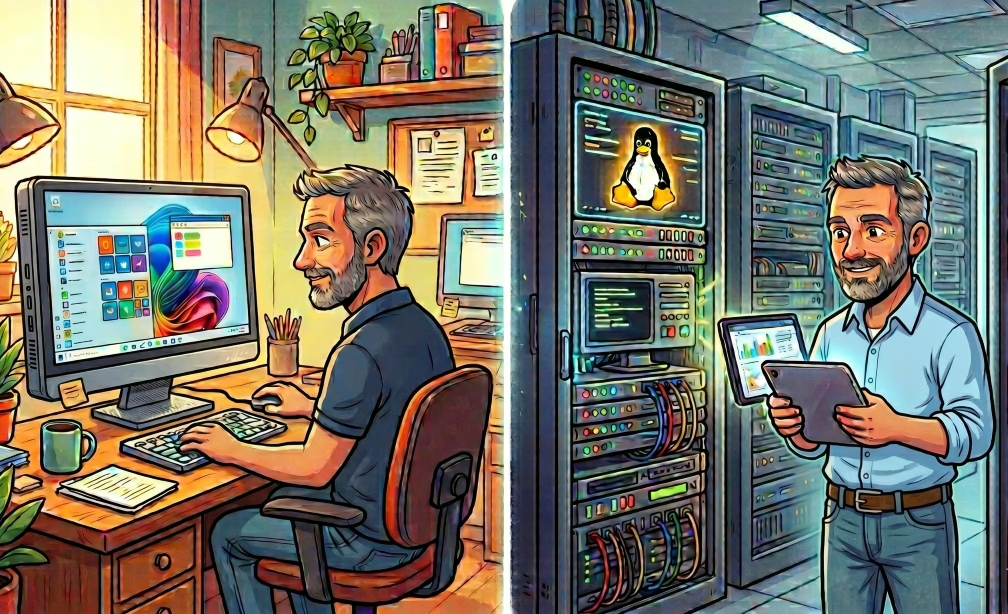
Conclusion: Windows for clients, Linux for servers
Windows isn’t the most elegant system out there. But it’s where vendors actually test, where drivers are designed to run without intermediaries, where an update doesn’t require you to check what broke. For primarily gaming use, this matters. Linux with all its flexibility still puts a layer between you and the software, and that layer eventually makes itself felt.
On servers it’s a different story: there Linux remains a champion, optimized over decades of collective work, lightweight, reliable. Raspberry Pi, VPS — everything runs on Linux without me having to think about it.
What I want to make clear is that going back to Windows didn’t mean giving up open source tools or the Linux environment. WSL2 is there, Docker containers run, the terminal works. It’s not a surrender, it’s a division of roles.
Some will say I’ve grown old. I prefer to think that after gaining more experience I decided to put the right tool in the right place. And as they say: only fools never change their minds.