I’ve been using Arch Linux as my main system for years. KDE Plasma on Wayland, hand-written configurations, manual package management. A system that rewards those who know it well and punishes those who forget where to look.
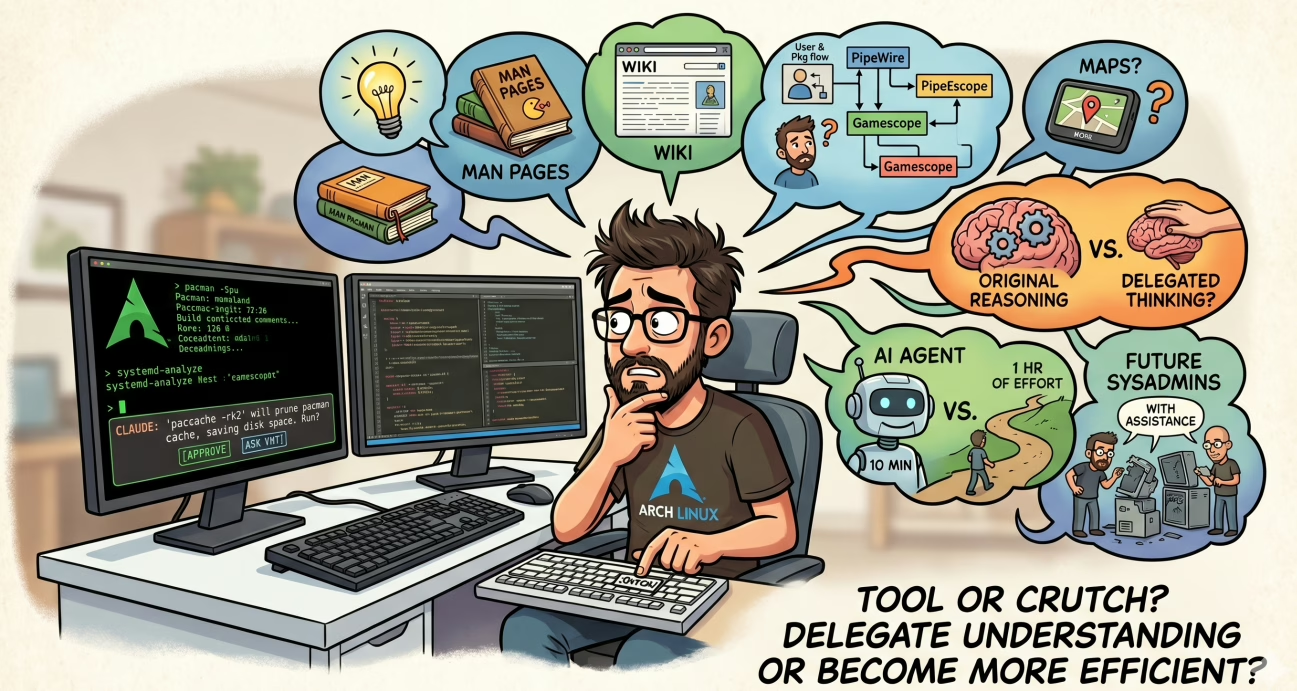
For the past few months I’ve been working alongside Claude Code, an AI agent that runs directly in the terminal. It doesn’t respond with lists of commands to copy: it executes them, reads the output, corrects course if needed, and explains what it’s doing and why. Cleaning up orphan packages, troubleshooting PipeWire after a kernel update, configuring the Proton/DXVK stack for gaming, KDE window rules to fix mouse coordinate issues with Wine. Things that used to take an hour between the wiki, forums, and man pages now get resolved in ten minutes.
The time savings are real. But I found myself wondering: at what cost?
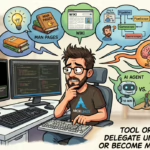
Tool or Crutch?
The upside I didn’t expect is the educational one. Claude Code doesn’t run silently: it explains why it uses paccache -rk2 instead of clearing the cache directly, what the difference is between Wants= and Requires= in a systemd unit, why certain Gamescope environment variables behave differently on Wayland than on X11. In theory, every session is also a learning opportunity.
In practice, though, I stop to read the explanations about one time in three. The other times I just approve and move on. And that’s where the uncomfortable question comes in: if I stop doing the mental work to reach the solution myself, am I becoming more efficient or am I simply delegating comprehension?
A sysadmin who uses these tools every day — will they still be able to reason through a problem from scratch in five years? Or will they need the agent even for things they can do from memory today?
The Comparison That Can’t Be Ignored
This isn’t a new question. We’ve already asked it about GPS navigation (can we still read a map?), spell checkers (can we still write?), calculators. Every time a tool automated a skill, we gained speed and lost something less measurable.
In the sysadmin’s work the risk may be more concrete, because complex systems keep breaking in unpredictable ways. And when the AI agent doesn’t know the answer, or gives the wrong one, someone needs to be able to reason without a safety net.
So Should You Use It?
Yes, without question. The alternative isn’t becoming better sysadmins by doing everything by hand: it’s wasting time on repetitive tasks instead of focusing on problems that genuinely require understanding.
The right question isn’t whether to use these tools, but how to use them without losing the thread. The answer probably lies in the habit of asking yourself, every once in a while, whether you’d be able to do the same thing without them. Not to prove anything, but to keep that part of the sysadmin trade alive — the part no agent will be able to fully replace, at least for now.
The future of system administration will almost certainly involve people working with AI agents. Hopefully they’ll be people who still understand what those agents are doing.