A few days ago I posted an article about how AI simplifies sysadmin tasks and the risk that this might erode expertise. It discussed this and what path might prevent it, along with questions about the future. A fairly harmless article. Moderate, I’d say. You can find it on this blog, just to get an idea. Then I posted the article on Reddit with a link and watched. The fierce reactions didn’t take long to arrive.
The article was later removed and my account banned from the community where I had posted it. The reason? The included link violated the community’s policy. A somewhat forced reason to justify an outright ban. But Reddit communities are unfortunately like that.
Reading the comments, though, there was much more to be read. Let’s accept the official reason — nothing to say about that… despite the obvious disappointment, to be clear. Don’t follow a rule? You face the consequences. Fair enough. Yet in the comments I read so much hatred, so much fear, so much resentment toward a technology that apparently is seen as absolute evil and the scourge of our time. And if for some reason you use those technologies to write better or to add a nice image to your article… you too are part of that evil.
This makes me think, looking at history, of when tractors were introduced and took work from farmers… or when the first automated machines took jobs from factories. Is this the fear we have as a society? Are we still at this point? Sure, it may be the usual cliché of those who justify new technologies… but isn’t this true for all the professions that are living through this change today?
Studies on those historical periods show that an initial period of job reduction was followed by enormously prosperous ones that made us grow not only as a society but as humanity. The growing well-being introduced by those technologies increased literacy, reduced mortality, and raised the average life expectancy of entire communities. It’s sad that we can’t see this.
But it’s also enormously understandable from the perspective of the individual. The farmer who has worked for years sees his skills swept away by machines that do the work of a hundred people like him without ever stopping. How many times have similar things happened in our history? How can you not feel crushed, cheated… helpless? Anger is the obvious next step.
So paradoxically, society in general improves but the individual remains crushed by the very progress that generated that improvement. How do you explain to the farmer that he’ll have to change jobs, or do the same job but differently… ultimately adapt to find his place again? His reaction, I repeat, is understandable. But in my opinion it’s also misdirected. Does it make sense to blame the tractor… or maybe the tractor manufacturers who are taking his job? Not very useful in my opinion. Or at least it shouldn’t be necessary in a civil society with a government that truly works in its citizens’ interests.
What we perhaps need to do is insist with our governments that they regulate the use of these new technologies, so that the transition period toward a new stability and balance is shortened as much as possible. Find ways to retrain people. Give back to society — which is losing employment opportunities — part of the lost value through concrete taxation that returns value to society. Ensuring that individuals are no longer crushed but guided toward an alternative, maintaining a sustainable social impact. It won’t be pleasant for everyone, let’s admit it. Quite the opposite. It will be traumatic for many.
And here I return to the disproportionate reaction of those Reddit users I started with. The same fear, albeit in a more polite and composed way, if you’ll allow me… I feel it myself as an IT professional. To give a simple example, even though this is just a hobby… I look at this site and wonder today what reason it has to exist. A blog in 2026 that talks a lot about AI and often uses AI itself to solve problems…
With such a powerful tool available to everyone, what’s the point of telling or documenting experiences with new technologies? AI lets us solve problems that until yesterday I would never have even thought to tackle. Hours of work become minutes. Thought becomes action and production-ready services in less than half a day. But with a ‘Genie in a Bottle’ granting infinite wishes available to everyone… what’s the point today of documenting or explaining how to do certain things? People will just ask AI, which will do the work directly, and impeccably at that.
My role remains that of the controller… sure… based on my experience and my validation criteria, which, incidentally, will ALWAYS need to be part of the equation to ensure safety and control. But a site like this… what’s its purpose today? It remains only the diary of an IT professional who recounts (often with the help of AI itself, because time is really short…) enthusiasm for new technologies. Does it only serve me as a place to write and share? What other value can it give a reader? I ask myself this just as today we all ask ourselves what our future will be.
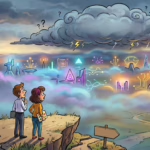
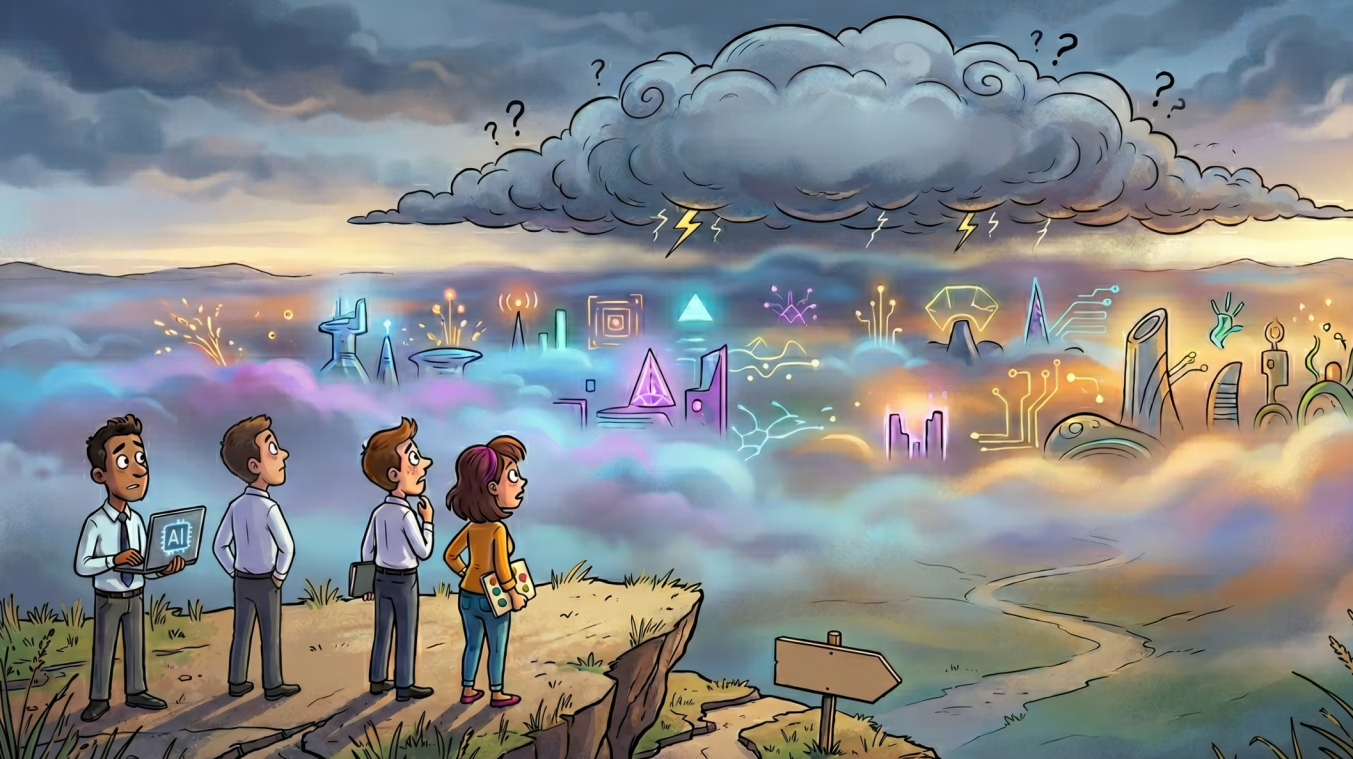
But I don’t accept that the conclusion must be negative and that we should remain stuck in this emotional swamp made only of uncertainties. I want to try to look ahead. I look toward a future where our way of working with these new tools will have become something different. Something better. One where a new technology finally finds its balance with people and becomes, in the right way, what it should have been from the start: the true extension of human capabilities.
Today we can do much more than we could yesterday. Let’s use this capability! Instead of blaming the technology and those who use it, let’s use it ourselves. Instead of sitting in our self-pity where we inevitably think (wrongly) that the past was necessarily better… let’s try to use these new extensions of our ability to act to do things that yesterday we wouldn’t have even thought we could approach.
I come back to this because it’s the most important point. If yesterday we could do something good… tomorrow we’ll be able to do something better. And this isn’t empty prose… it’s reality. Just stop fixating on problems like “oh no… poor me… I didn’t really write those two lines of code myself!! Where will this all end??”. Don’t let fear of the unknown stop us. It should help us do things the right way… protect us from our mistakes. But not stop us. Let’s try to look ahead… let’s lift our gaze beyond our own feet.
The future is always an unknown… but stagnating in our fears… in our ‘comfort zone’ where we end up only feeling sorry for ourselves leads nowhere. We share the same fears together, my worries are still there. The unknowns haven’t disappeared. Do I fear for the future of my profession, as I do for all those who find themselves confronting these technologies? Yes, very much.
Here I share some of my experiences throughout all of this. Perhaps this is the true value this site brings. Let’s take a step forward… let’s try to use these technologies with our experience, our desire to do. Always with rationality, responsibility, and concreteness. We don’t know where this will take us tomorrow and I would so love to have reassuring answers for everyone. But of one thing I am certain: it’s always better than letting yourself be governed by the fear of the future.